Read the set code
Under the artwork on the right: LOB-001 is the 2002 Legend of Blue Eyes print, LOB-EN001 the 2004 worldwide reprint. The code names the set and rules out every other reprint.
 CardLens
Card scanners
Card values
Tools
Language
Yu-Gi-Oh! card value
Blue-Eyes White Dragon exists as a fifty-cent common and as a 1st Edition LOB-001 that has sold for five figures in a PSA 10. What separates them is printed on the card: the set code, the rarity foil, and the edition text. This page shows how to read them. CardLens reads them from a photo and shows what copies like yours have been selling for on eBay.
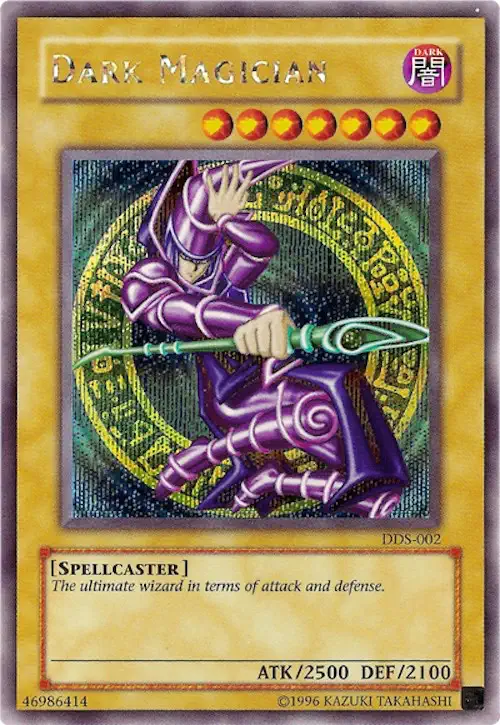
Dark Magician
Dark Duel Stories promo · DDS-002 · Prismatic Secret Rare · 2002
Sample result. Values move with the market; the app shows the current range when you scan.
The short answer
Konami reprints popular cards in many sets and several rarities. The print is what has a price, and three lines on the card name it.
Under the artwork on the right: LOB-001 is the 2002 Legend of Blue Eyes print, LOB-EN001 the 2004 worldwide reprint. The code names the set and rules out every other reprint.
Rarity is in the foil pattern rather than in text. Edition is a line of 1st Edition text, under the art on older cards and beside the passcode on cards since 2014, or no text for Unlimited. Both change the price, sometimes by multiples.
Near Mint and Lightly Played prices can be far apart on a vintage Ultra Rare. Compare completed sales of the same set code, rarity, and edition, in your condition.
What decides the price
You can do this with the card in hand and a good lamp. A scan reads it from the photo and shows the sales.
Every Yu-Gi-Oh! card carries a set code under the artwork: set abbreviation, language, and number. LOB-001 is the first English print of Blue-Eyes White Dragon, from the 2002 Legend of Blue Eyes release; LOB-EN001 is the same card from the 2004 worldwide reprint, and the two sell in different brackets. SDK-001 is the Starter Deck Kaiba print, and a code from a Mega Tin or a Structure Deck is a later reprint again. Same card, four prices, one line to tell them apart.
The eight-digit passcode in the bottom-left corner is the same on every print of a card. It identifies the card for the game, not the print for the collector, so the set code is the line to read.
Common, Rare, Super Rare, Ultra Rare, Secret Rare, Ultimate Rare, Ghost Rare, Starlight Rare, Collector's Rare, and Quarter Century Secret Rare are told apart by the foil on the artwork and the name rather than by any text. Konami often prints one slot in more than one rarity, so a set code alone can point to two or three prints with very different prices.
Hold the card to a lamp and tilt it. A Secret Rare shows a diagonal shimmer, an Ultimate Rare has a textured foil on the art and frame, a Ghost Rare is pale and ghostly across the whole card. In a scan, angling the light does the same job.
The earliest print run of a set carries 1st Edition text: under the left edge of the artwork on cards printed before 2014, and beside the passcode in the bottom-left corner on cards since. Later runs have no edition text and are called Unlimited. Promos and prize cards say Limited Edition, as do the promo cards from the older Collectible Tins; Mega-Tin packs are 1st Edition. For vintage cards the 1st Edition premium is large: a 1st Edition LOB-001 Blue-Eyes and an Unlimited one sell in different price brackets entirely.
The text is small and easy to miss. It is the third thing to check on any card older than a few years.
Cards printed for Japan and Asia belong to the OCG, with their own set codes, their own rarities such as 20th Secret Rare and Holographic Rare, and their own market. Asian-English OCG cards look like TCG cards at a glance. A Japanese print of a popular card can be worth more or less than the English one depending on the rarity and the print run, so compare sales of the actual language.
Prize cards from championships and early promos from video games, like the Dark Duel Stories set above, are their own entries with their own, often very high, prices.
Raw cards are priced Near Mint through Damaged, and vintage Yu-Gi-Oh! cards are often played, with edge wear and surface scratches from sleeves that were not always used. A Near Mint vintage Ultra Rare is scarce, and grading rewards it: high PSA grades of early prints sell for many times the raw price.
CardLens estimates the condition from a photo and reads the grade on PSA, BGS, and CGC slabs, so the sales behind each range are the right sales.
Commons and Unlimited reprints are bulk. The first tier that moves is playable Super and Ultra Rares from current sets, a few dollars to a few tens, with Secret and Quarter Century versions above them. Vintage 1st Edition Ultra and Secret Rares, Ghost Rares, and Starlight Rares of popular monsters run from tens into the hundreds. At the top sit early video game promos, championship prize cards, and graded 1st Edition LOB and SDK cards, from hundreds to five figures.
A scan places your card in its tier and shows the sales that put it there.
Check by photo
On the playmat under a lamp, tipped until the foil pattern shows, with the set code and edition text in the frame.
Check the set code under the artwork and the edition text against the match on screen, and confirm the rarity looks right for the foil.
See a value range built on recent eBay sales of that print, with the sales listed, plus a condition grade. Save the card to keep tracking it.
Before you trade at locals
Match the set code and edition first. A range for the exact print, backed by sales of that print, is the number a buyer will accept.
A listing photo that shows the Secret or Ultimate foil clearly sells faster. The same angle that helps the scanner helps the buyer.
Early 1st Edition Ultra and Secret Rares in clean condition are where grading pays. Look at how graded copies of the print have sold before you submit.
Questions
Read the set code under the artwork, check the foil for the rarity, and look for 1st Edition text. Early sets, high rarities, 1st Editions, promos, and prize cards are where value lives. A scan reads all three and shows what copies of that print sold for.
1st Edition Ultra and Secret Rares from the earliest sets, championship prize cards, early video game promos, Ghost and Starlight Rares of popular monsters, and graded copies of all of the above. Most commons and unlimited reprints are worth little.
For most sets, and for vintage sets by a wide margin. Compare 1st Edition sales with Unlimited sales of the same set code to see the actual gap for your card.
Scan the card and the set code appears with the match, alongside a value range built on recent eBay sales of that print. You can also browse and search the catalog by game inside CardLens.
Sometimes. OCG cards have their own rarities and print runs, and some Japanese prints are scarcer than the English ones. Compare sales of the actual language and rarity rather than assuming either way.
CardLens scans a Yu-Gi-Oh! card on iPhone, matches the set code, rarity foil, and edition, and shows a value range built on recent eBay sales of that print, with the sales listed.
Free on the App Store
Free on the App Store. Set code, foil, and edition read off the card, with the eBay sales that price them.