MTG card scanner: the printing, the foil, and the price of any Magic card
A Magic card name can belong to twenty printings. CardLens is a Magic card scanner app for iPhone that reads the set code, collector number, frame, and foil from a photo, matches the exact printing, and shows a value range built on recent eBay sales with a condition grade. Alpha through the newest set.
Sample result. Values move with the market; the app shows the current range when you scan.
Which printing is this?
Which printing, what it sells for, what shape it is in
Lightning Bolt from Alpha and Lightning Bolt from a Starter deck are the same card in a game and different objects in a collection. CardLens answers the collection question.
01
The exact printing
Set, collector number, and frame. From 2014 onward the set code sits with the number bottom-left; from Exodus in 1998 to 2014 the scanner reads the collector number and set symbol; before that it uses the set symbol, border, frame, and artist line. Reprints are matched to their own set, never to the first printing of the name.
02
A value range with eBay evidence
The range comes from what copies of this printing and finish have been selling for on eBay, and you can open those sales. Magic collectors are used to a TCGplayer market price; this is the other half of the picture, what copies have gone for recently.
03
A condition grade
A raw estimate on the Near Mint to Damaged scale, which is the scale the singles market prices in, and a read of the label on PSA, BGS, and CGC slabs. Vintage cards are often played, and a Lightly Played Beta card is still a serious card.
How a Magic card gets identified
Reprints, foils, and frames: what separates one copy from another
Magic has been printed since 1993 and reprints its best cards constantly. The identifiers changed over the years, and the scanner has to read whichever era the card comes from.
Collector number and set code
Cards printed since the 2014 frame carry a collector number, a three-letter set code, and a language code along the bottom-left edge; until 2023 the number was printed over the set size, and since March of the Machine it is a plain four-digit number. That line identifies one printing: the same card in a Collector Booster carries a higher number than the regular copy, and a promo carries its own set code entirely.
The Mystery Booster and The List reprints show a small planeswalker symbol in the same corner. The scanner reads the symbol and files the card under the right product, which matters because List reprints usually sell for less than the original.
Alpha, Beta, Unlimited, and the Collectors' Edition
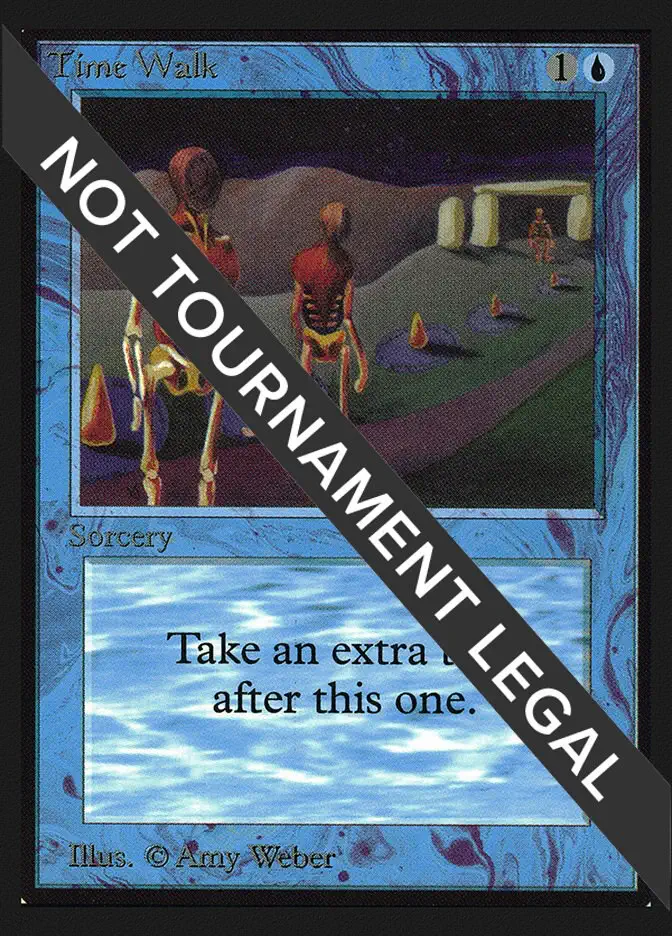
The first three Magic sets have no set symbol and no collector number. Alpha is told by its more rounded corners, Beta by its black border and standard corners, Unlimited by its white border. The Collectors' Edition and International Edition reprinted the same cards in December 1993 with square corners and a gold border on the back, and they are not tournament legal. A Time Walk from that set sells for a small fraction of an Unlimited copy, which is why the sample scan above names the set and not just the card.
Sets from Arabian Nights to Exodus have a set symbol but no number, so the scanner leans on symbol, frame, artwork, and the artist credit when two sets share art.
Foil is not one thing
A traditional foil and a non-foil are usually priced apart. Since 2020 Magic has added etched foil, surge foil, textured foil, galaxy foil, halo foil, and serialized cards, most of them limited to Collector Boosters or Secret Lair drops. The finish is part of the match, so a surge-foil printing is never valued against a regular one.
Frame treatments count too. Borderless, extended-art, and showcase versions carry their own collector numbers, and CardLens reports the frame with the number.
Since 1996 Wizards of the Coast has promised not to reprint a set of older cards, the Reserved List. Dual lands, the Power Nine, and many Legends and Arabian Nights rares live there. Their prices behave differently from cards that can be reprinted in the next Commander deck, and the eBay sales behind a Reserved List card tend to be fewer and more spread out.
A wide range on one of those cards is the market being thin. The app shows the sales so you can judge the spread yourself.
Foils and etched cards read best with the lamp off to one side so the pattern does not wash out the type line. Keep the whole card in the frame.
2
Confirm the printing
Check the set code and collector number against the bottom-left corner of the card. For vintage cards, check the border and corners against the match.
3
See the range, save the card
The value range and its eBay sales appear with the condition grade. One tap saves the card to your vault; the collection total updates with it.
Before you buylist
Three habits of Magic collectors who get full price
Side light for foils and etched cards
Move the lamp to one side so the foil pattern shows without washing out the text. The scanner reads the finish from the photo, and a clear finish means the range comes from the right printing.
Check the corner, then the range
The set code and collector number on screen should match the bottom-left of the card. For vintage cards, match the border and corners. Once they agree, the eBay sales behind the range are sales of your card.
Scan the binder, not just the chase cards
A vault that holds the whole collection shows a total worth looking at. Reopen a saved card and its market evidence refreshes, so the number stays current without any typing.
Questions
MTG card scanner questions, answered
Is there an MTG card scanner app for iPhone?
CardLens is a Magic card scanner app for iPhone that identifies the set, collector number, frame, and foil type from a photo and shows a value range built on recent eBay sales.
Can I use it as an MTG card price checker app?
Scan a Magic card and CardLens shows a value range built on recent eBay sales of that exact printing and finish, with the sales listed. It is a price checker built on eBay evidence rather than a TCGplayer feed, so the two can differ.
Can the scanner tell a foil from a non-foil?
The finish is part of the match: non-foil, traditional foil, etched, surge, and the other Collector Booster treatments are matched and priced as separate printings.
Does it recognize old cards without collector numbers?
For Alpha, Beta, Unlimited, Revised, and every set before Exodus, the scanner uses the set symbol where there is one, plus border, corners, frame, and artist credit, to place the card in its set.
Does it work with Commander and Secret Lair cards?
Commander deck printings and Secret Lair drops have their own set codes and collector numbers, and the scanner reads them the same way it reads a booster card.
Does it work as an MTG collection scanner app?
Every scanned card can be saved to the vault, and the vault shows a total value that refreshes as you reopen cards. The same vault holds your Pokémon, Yu-Gi-Oh!, One Piece, and Lorcana cards.
Free on the App Store
Find out which printing you own.
Free on the App Store. Alpha to the latest set, with the frame and the foil in every match and the eBay sales behind every range.

 Black Lotus
 Mox Opal