Read the number and the rarity letter
OP01-001 with an L is a leader from Romance Dawn; OP01-016 with an R is a rare from the same set. The letter tells you the printed rarity of the base version.
 CardLens
Card scanners
Card values
Tools
Language
One Piece card value
In the One Piece Card Game the same card number can be a common pull or a money card, because parallels, manga arts, and special parallels share numbers with their base prints. This page shows how to tell them apart and what else moves the price. CardLens reads it all from a photo and shows what copies like yours have been selling for on eBay.
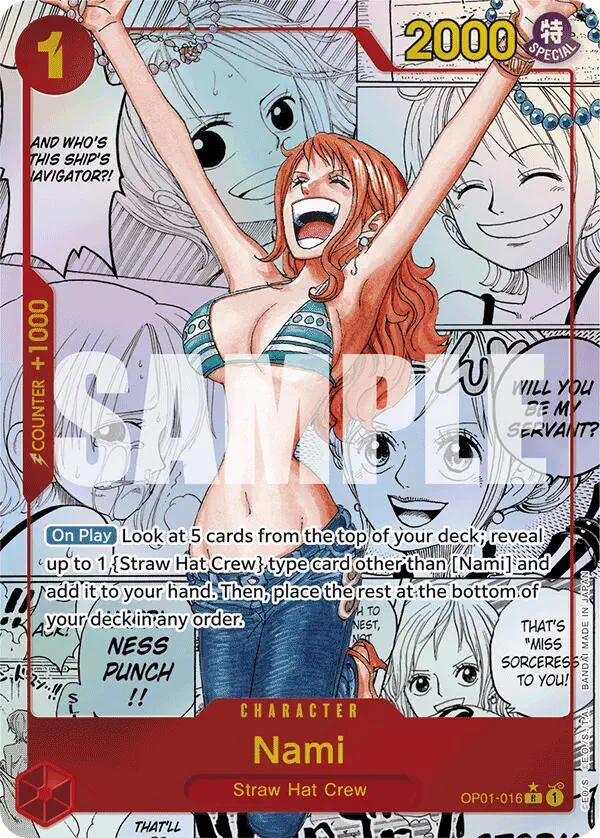
Nami
OP01-016 · Manga art · ONE PIECE CARD THE BEST · English
Sample result. Values move with the market; the app shows the current range when you scan.
The short answer
Bandai's numbering names the card and the finish names the money. Read the number, then look hard at the art and the foil, then compare sales of exactly that.
OP01-001 with an L is a leader from Romance Dawn; OP01-016 with an R is a rare from the same set. The letter tells you the printed rarity of the base version.
Base, parallel, special parallel, manga art, or treasure rare. Same number, different card, and the gap between a base rare and its manga art can be a thousandfold.
Japanese and English prints sell in separate markets. Full-art cards show edge wear easily, so condition matters. Then compare completed sales of the same number, finish, and language.
What decides the price
You can do this with the card in hand. A scan reads the number and the finish from the photo and shows the sales.
Every card carries a code in the bottom-right corner: OP for booster sets, ST for starter decks, EB for extra boosters, PRB for premium boosters, and P for promos, followed by the set and the card number. Beside it sits the rarity: C, UC, R, SR, SEC, or L for leaders. That pair names the card and its base rarity, and it is where any value check starts.
It is also where a name-only lookup stops, which is why so many One Piece values online are wrong for the card in your hand.
A parallel is the alternate-art foil version of a card at the same number, and it is the version collectors chase. Later sets added special parallels with a distinct frame, manga-art cards that reproduce a manga panel, and treasure rares. The base print of a popular rare might sell for a few dollars; its manga art from a premium booster can sell for four figures.
You tell them apart by the art and the foil rather than the number. A scan does the same, and reports the finish next to the code.
Leader cards are printed horizontally and sit at the front of each set. Their parallels are among the most valuable cards in each release. DON!! cards exist in the standard print and in event and promo versions with alternate art. Tournament prize cards, winner cards, and shop-event promos carry the highest prices in the game.
If a card came from an event rather than a booster, its value is a promo value, and the match should name the event.
The game launched in Japan in July 2022 and in English that December. For its first years Japanese sets released months ahead of the English versions, and Bandai has since moved to near-simultaneous worldwide releases. The two markets still price separately: a Japanese parallel can be worth more than the English one on release and less a year later, or the reverse.
Compare sales of the actual language. A scan names the language in the match so the sales it shows are the right market.
Full-art parallels and manga arts have dark borders that show edge wear at a glance, so the step from Near Mint to Lightly Played is visible and priced. Graded copies of top parallels and manga arts sell for multiples of raw copies, and grading is common for the game's money cards.
CardLens estimates condition from a photo and reads the grade on PSA, BGS, and CGC slabs, so the sales behind each range are the right sales.
Base commons, uncommons, and most base rares are bulk. The first tier that moves is playable super rares and leader cards, a few dollars to a few tens. Parallels of popular characters run from tens into the hundreds, and leader parallels from the early sets sit at the top of that band. Manga arts, special parallels, treasure rares, and tournament promos run from hundreds into four figures raw, and graded copies go beyond.
A scan places your card in its tier and shows the sales that put it there.
Check by photo
Plain background, the lamp a little to one side so the foil on a parallel shows, the corner code in the frame.
Check the code in the bottom-right corner and the finish label on screen against the card: base, parallel, SP, or manga art.
See a value range built on recent eBay sales of that print, with the sales listed, plus a condition grade. Save the card to keep tracking it.
Before you sell
Buyers search for parallel, SP, and manga art by name. Price off sales of that finish and say it in the title, and the listing sells.
Prices in a young game move fast in both directions. CardLens shows the recent sales behind every range, so you price on the current market.
Leader parallels, manga arts, and promos in Near Mint condition are where grading pays. Look at how graded copies of the print have sold before you submit.
Questions
Read the number and rarity letter in the bottom-right corner, identify the finish from the art and foil, note the language, judge the condition, then compare recent sold prices for exactly that print. CardLens does the identification from a photo and shows the eBay sales.
Leader parallels, manga arts, special parallels, treasure rares, and tournament promos of popular characters. Base commons and uncommons are worth little, and most base rares are inexpensive.
It depends on the card. For the game's first years Japanese prints arrived months early and sometimes carried a release premium; with near-simultaneous releases the gap is now about print run and demand. Compare sales of the actual language.
A parallel has alternate, usually full-bleed artwork, a foil finish, and from OP04 onward a star above the rarity letter, all at the same number as the base card. Manga arts show a manga panel. A scan reports the finish next to the number so you do not have to guess.
Individual cards rise and fall as sets rotate and reprints arrive, which is normal for a young game. The useful question is what your specific print sold for this month, and that is what a scan shows.
CardLens scans a One Piece card on iPhone, matches the number and the finish, and shows a value range built on recent eBay sales of that print, with the sales listed.
Free on the App Store
Free on the App Store. Number, finish, and language read off the card, with the eBay sales that price them.