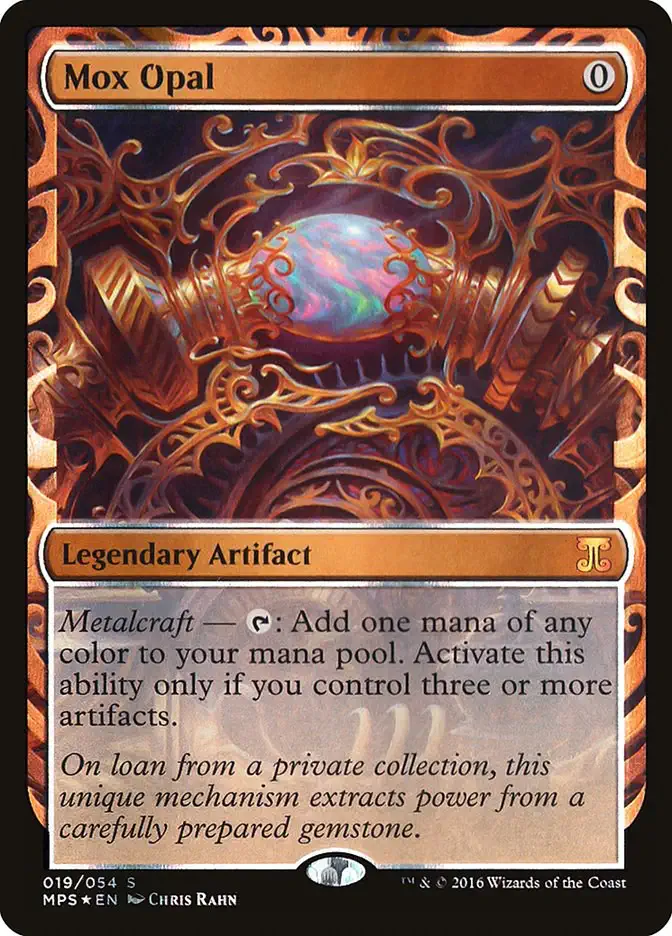
MTG card value: how much are my Magic cards worth? The printing decides
A Magic card's value is the value of one specific printing in one specific condition. The same name can be a bulk rare from a recent set and a four-figure card from 1993. This page shows how to read the printing off the card. CardLens reads it from a photo and shows what copies like yours have been selling for on eBay.
Sample result. Values move with the market; the app shows the current range when you scan.
The short answer
Magic card value is what recent sales say about your printing, in your condition
Magic reprints its best cards constantly, and each printing has its own price. Find the printing, note the finish and frame, judge the condition, then look at sold prices for exactly that.
01
Find the printing
On a card from 2014 onward the set code and collector number sit bottom-left. From 1998 to 2014 the collector number and set symbol tell the set. Before Exodus, the set symbol, border, and frame do. That is the card that has a price.
02
Note the finish and the frame
Non-foil, traditional foil, etched, surge, and the rest are priced apart. Borderless, extended-art, and showcase frames from Collector Boosters carry their own numbers and their own prices.
03
Judge condition, then use sold prices
Near Mint and Lightly Played copies of an expensive card can differ by a third. Compare your copy with completed sales of the same printing in the same condition, not with listings.
What decides the price
MTG card value guide: how to read value off a Magic card
You can do all of this with the card in hand. A scan does the reading for you and shows the sales.
1. Which printing: set code, collector number, set symbol
Since the 2014 frame, every card shows its collector number, a three-letter set code, and a language code in the bottom-left corner; older modern cards print the number over the set size, and cards since 2023 use a plain four-digit number. That line names one printing. A Sol Ring from a Commander deck, a Sol Ring from a Secret Lair, and a Sol Ring from a Masterpiece series are three cards with three prices, and the corner tells you which you hold.
Cards from Exodus in 1998 to 2014 carry a set symbol in the middle-right of the frame and a collector number along the bottom edge. Alpha, Beta, and Unlimited have neither: Alpha has more rounded corners, Beta a black border, Unlimited a white one. Those three sets hold the most valuable cards in the game, and telling them apart is the first job.
A traditional foil usually sells for more than the non-foil, sometimes several times more for older sets where foils were scarce. Since 2020 the game has added etched foil, surge foil, textured foil, galaxy foil, halo foil, and serialized cards numbered out of a fixed print run. Most live in Collector Boosters and Secret Lair drops, and each is priced on its own.
The finish is visible in hand and in a well-lit photo. It is the second thing to settle after the printing.
3. Frame treatments and Collector Booster versions
Borderless, extended-art, and showcase versions of a card share its name and rules text and carry their own collector numbers, usually higher than the regular version. In many sets the borderless foil is the most expensive version of the card, and the regular non-foil is the cheapest, with a gap of ten times or more between them.
Promo stamps, prerelease foils with a date stamp, and The List reprints with the small planeswalker symbol are all their own entries too.
4. The Reserved List
Wizards of the Coast has promised since 1996 never to reprint the cards on the Reserved List: the Power Nine, the original dual lands, and many rares from Legends, Arabian Nights, Antiquities, and The Dark. Their supply is fixed and their prices behave like collectibles rather than game pieces. If your old card is on the list, it deserves a careful look at condition and at graded sales.
Cards that can be reprinted, which is almost everything else, move with the game: a reprint in a new Commander deck can halve a price in a month.
5. Condition and grading
Raw Magic cards are priced Near Mint, Lightly Played, Moderately Played, Heavily Played, or Damaged, and the singles market lives almost entirely in the first two. Vintage cards are often played, and a Lightly Played Beta card is still a serious card. Graded copies are a separate market: high-grade Alpha and Beta cards sell for multiples of raw ones, and grading is standard for the Power Nine.
CardLens estimates condition from a photo of the front and reads the grade on PSA, BGS, and CGC slabs, so the sales behind each range are the right sales.
Most commons and uncommons from the late 1990s onward are bulk. The first tier that moves is Commander staples and format-playable rares, a few dollars to a few tens, with foils and borderless versions above them. Reserved List rares from Legends, Arabian Nights, and The Dark, plus dual lands, run from tens into the hundreds. At the top sit Alpha, Beta, and Unlimited power and duals, where raw copies run four and five figures and graded copies far beyond.
A scan places your card in its tier and shows the sales that put it there.
Check by photo
How to check a Magic card's value by photo, in three steps
1
Photograph the card
Sleeve off, plain background, light from the side for foils so the pattern shows and the type line stays readable.
2
Confirm the printing
Check the set code and collector number on screen against the corner of the card, or the border and corners for a vintage card.
3
Read the sold prices
See a value range built on recent eBay sales of that printing and finish, with the sales listed, plus a condition grade. Save the card to keep tracking it.
Before you buylist
Three habits that get the full price for a Magic card
Match the corner before you quote
A range for the exact printing and finish, backed by sales of that printing, is the number a buyer at a shop or on a marketplace will accept. Feeds lag; sales do not.
Know which version you are holding
Regular, borderless, extended-art, showcase, foil, etched: the corner and the surface tell you, and the price follows. Sell the borderless foil as a borderless foil.
Grade the vintage, keep the rest raw
Alpha, Beta, and Reserved List cards in clean condition are where grading pays. Look at how graded copies have sold before you submit; modern cards sell fine raw.
Questions
Magic card value questions, answered
How do I find out what my Magic cards are worth?
Identify the printing from the set code and collector number, note the finish and frame, judge the condition, then look at recent sold prices for that exact printing. CardLens does the identification from a photo and shows the eBay sales.
Is there a Magic the Gathering card value scanner?
CardLens scans a Magic card on iPhone, matches the set, collector number, frame, and finish, and shows a value range built on recent eBay sales of that printing. It covers Alpha through the newest set.
Are my old Magic cards worth anything?
Cards from Alpha, Beta, Unlimited, Arabian Nights, Legends, and Antiquities are the ones to check first, along with any dual land. Most commons and uncommons from the late 1990s onward are worth little, and a scan tells you which pile a card belongs in.
Is a foil always worth more?
Usually, and often by a lot for older sets. Exceptions exist where foils were printed in large numbers. Compare foil sales with non-foil sales of the same printing rather than assuming.
What is the Reserved List and does it affect value?
It is a list of older cards Wizards of the Coast has promised never to reprint. Supply is fixed, so those cards hold value differently from cards that can appear in the next reprint set.
Should I get my Magic cards graded?
For Alpha, Beta, and other vintage cards in clean condition, compare raw and graded sales. When the graded price clears the fee with room to spare, it is worth submitting. Modern cards usually sell best raw.
Free on the App Store
Find out what your Magic cards are worth.
Free on the App Store. Set code, frame, and finish read off the card, with the eBay sales that price it.